Doodaro prompt cheatsheet: 10 fill-in templates for briefs and scene descriptions (2026)
Ten copy-and-fill templates for the Story brief and per-scene picture descriptions, each with a good example and a bad one to avoid.
Last checked
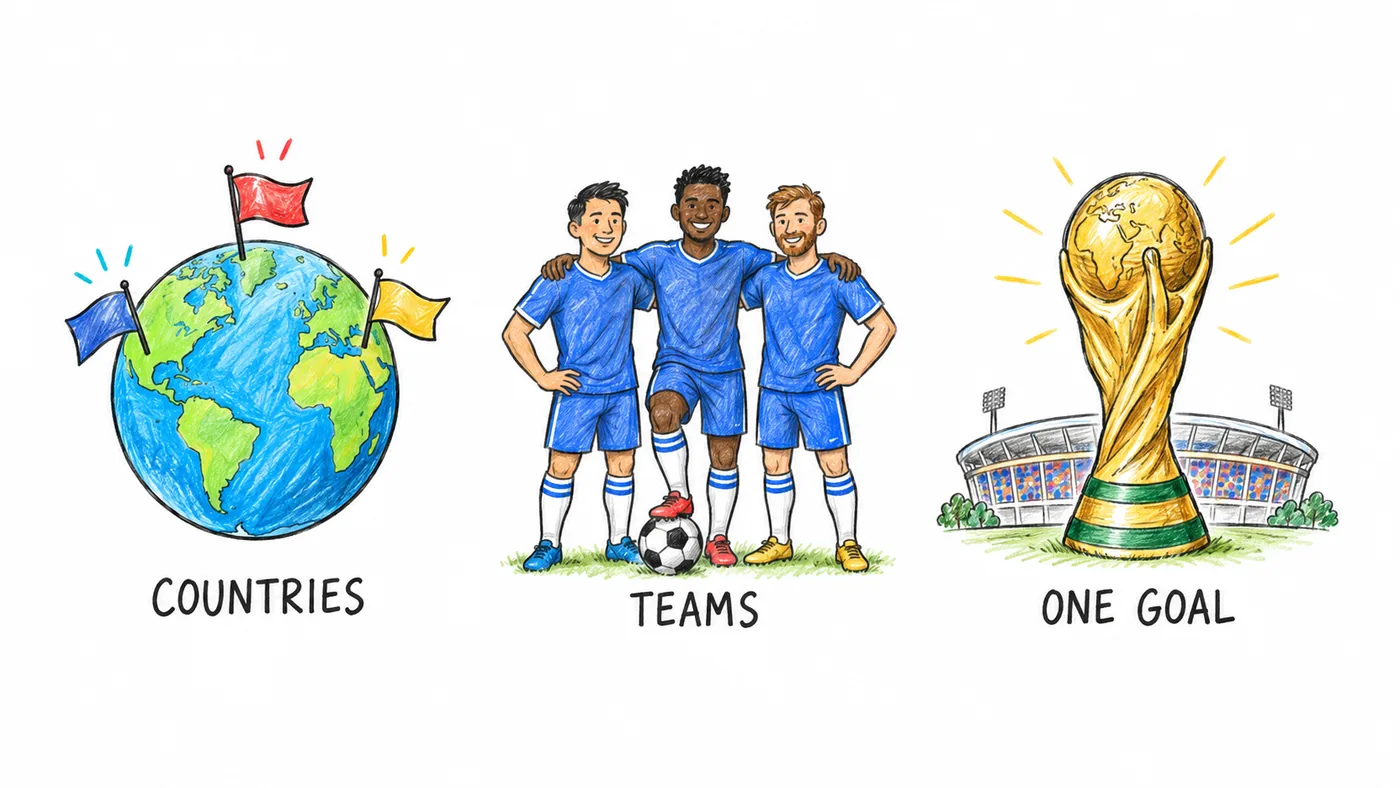
Doodaro asks you for words in two places. The brief on the Story screen tells the assistant what to write. The picture description on each Storyboard card tells the studio what to draw. Both work best when they are specific and short.
This page gives you ten templates for both. Copy one, fill the blanks, paste it in.
Rules that apply to every template
For the brief:
- Say the subject, the audience and the takeaway in the first sentence.
- Say what you do not want (“no jargon”, “no jokes”).
- Set Audience, Language and Target length in the fields, not in the text.
- Use Recurring characters and details for anyone who appears more than once.
For picture descriptions:
- One picture, one idea. If you need two ideas, split the scene.
- Subject first, action second, setting third.
- Name objects the viewer will recognize at a glance (a clock, a ladder, a piggy bank).
- Do not mention colors, line weight, “whiteboard” or “sketch”. The style you picked already covers that.
- Keep text inside the picture to a label or a number.
A bad description is not wrong grammar. It is vague (“something about growth”), overloaded (six things in one frame) or fighting the style (“photorealistic, 4k”).
1. YouTube explainer
Brief template
Explain [topic] to [audience] in [length]. Start with the question people actually type into search, give a clear answer in the first 20 seconds, then cover [point 1], [point 2] and [point 3]. End with one thing the viewer can do today. Plain words, no hype.
Good brief
Explain why bread goes stale to home bakers in 3 minutes. Start with the question “why is my bread hard the next day?”, answer it in the first 20 seconds (starch recrystallizes, it is not drying), then cover how to store it, how to revive it and why the fridge makes it worse. End with one thing to do today. Plain words, no hype.
Bad brief
A video about bread.
Scene description template
[Person or object] [doing one thing] with [one object that carries the point]. Label: “[one word]”.
Good scene
A loaf of bread on a kitchen counter with a small clock beside it showing the next morning. Label: “Day 2”.
Bad scene
Show bread going stale over time with a chart, a fridge, a person looking sad, and some text explaining starch retrogradation in detail.
2. Lesson
Brief template
Teach [concept] to [grade or level] in [length]. Learning objective: by the end, students can [verb + skill]. Cover three ideas in order: [idea 1], [idea 2], [idea 3]. Include one worked example and one check-for-understanding question at the end.
Good brief
Teach fractions on a number line to grade 4 in 3 minutes. Objective: students can place 1/2, 1/4 and 3/4 on a number line. Cover: a number line is a ruler, fractions split the gap between 0 and 1, bigger denominators mean smaller steps. One worked example placing 3/4. End with the question “where does 2/4 go?”
Bad brief
Fractions lesson, make it fun and engaging for kids of all ages.
Scene description template
A [diagram or object] showing [one relationship]. [One element] is marked. Label: “[value]”.
Good scene
A horizontal number line from 0 to 1 with four equal ticks. The third tick has an arrow pointing to it. Label: “3/4”.
Bad scene
A number line with all the fractions from halves to twelfths and a teacher explaining each one.
3. Devotional
Brief template
A [length] devotional on [passage, book chapter:verses] for [audience]. Read or paraphrase the passage, draw out one idea, and connect it to [everyday situation]. Attribute any interpretation (“one way to read this is”). End with a short prayer or reflection question. No invented quotes.
Good brief
A 90-second devotional on Psalm 23:1-3 for people going through a hard week. Paraphrase the verses, draw out the idea that rest is something we are led to, not something we earn, and connect it to feeling behind at work. Attribute interpretations. End with a one-line reflection question. No invented quotes.
Bad brief
Inspirational faith video, powerful and life-changing, with God speaking directly to the viewer.
Scene description template
[A person or scene from everyday life] that shows [the passage’s image] without depicting the divine. Label: “[reference]”.
Good scene
A person sitting on a bench beside a still pond, shoulders relaxed, a heavy backpack set down on the ground beside them. Label: “Psalm 23:2”.
Bad scene
God reaching down from the clouds with a glowing hand toward a tiny person.
4. Product explainer
Brief template
Explain what [product] does for [customer] in [length]. Open with the problem they have today, show the three steps of using [product], and close with the result. Use the customer’s words, not our feature names. No pricing.
Good brief
Explain what Ledgerly does for freelance designers in 2 minutes. Open with the problem: invoices in three places and a late-payment surprise at month end. Show three steps: connect your bank, tag a payment, get a Friday summary. Close with the result: knowing what is owed before it is late. Use the customer’s words. No pricing.
Bad brief
Ledgerly is the most powerful, seamless, AI-driven finance platform for modern creatives. Highlight all 14 features.
Scene description template
[The customer] at [their real workplace] doing [the step], with [one screen or object] visible. Label: “Step [n]”.
Good scene
A designer at a small desk holding a phone. On the phone is a single card with a checkmark. A coffee cup and a sketchbook sit nearby. Label: “Step 2”.
Bad scene
The full Ledgerly dashboard with every menu, chart and notification visible, rendered in exact brand colors.
5. Ad
Brief template
A [length] ad for [product] aimed at [audience]. First 3 seconds: [the itch]. Middle: one promise, shown not listed. Last 5 seconds: [one action]. Total under [word count] words. No superlatives.
Good brief
A 30-second ad for a folding standing desk aimed at people working from small apartments. First 3 seconds: the kitchen table is your office again. Middle: one promise, a desk that folds flat behind the sofa, shown in three quick scenes. Last 5 seconds: “Try it for 30 nights.” Under 70 words. No superlatives.
Bad brief
A viral, emotional, high-energy ad that goes hard and makes everyone want the best desk ever made.
Scene description template
[Person] [before or after moment] in [a small, recognizable place]. One prop only.
Good scene
A person eating breakfast at a kitchen table that has a laptop, a plate and a stack of papers fighting for space.
Bad scene
A montage of happy people in many locations enjoying the desk with dynamic camera moves and lens flare.
6. History
Brief template
Tell the story of [event or person] for [audience] in [length]. Give the date and place in the first line. Follow the order: what people expected, what actually happened, what changed after. Use only facts you can source; say “historians think” where there is debate. No dialogue that was not recorded.
Good brief
Tell the story of the 1854 Broad Street pump for a general adult audience in 4 minutes. Open with London, August 1854. What people expected: bad air causes cholera. What happened: John Snow mapped the deaths and had the pump handle removed. What changed: the start of modern epidemiology. Say “historians think” where the evidence is thin. No invented dialogue.
Bad brief
Epic history of medicine from ancient times to today.
Scene description template
[A place or object from the period] with [one human figure doing one thing]. Period details: [two items]. Label: “[year]”.
Good scene
A street water pump on a cobbled corner with a man in a long coat kneeling beside it, a rolled map under his arm. Period details: gas lamp, wooden cart. Label: “1854”.
Bad scene
A dramatic scene of the cholera epidemic showing suffering, doctors, maps, the pump, Parliament and a timeline of medical history.
7. Kids
Brief template
A [length] story for children aged [range] about [one lesson]. One main character, [name and one trait]. Short sentences. One problem, one try that fails, one try that works. End with the lesson said in one line a child would repeat.
Good brief
A 2-minute story for children aged 4 to 6 about sharing. Main character: Bo, a small bear who loves his red kite. Short sentences. Problem: two friends want a turn. First try: Bo hides the kite and nobody has fun. Second try: they take turns and the kite flies higher. End line: “More hands, higher kite.”
Bad brief
An educational children’s video covering kindness, sharing, honesty, safety and manners with lots of characters.
Scene description template
[Character] [one clear action] in [simple setting]. Big shapes, one prop.
Good scene
Bo the small bear holding a red kite above his head on a grassy hill, two friends watching from the bottom of the hill.
Bad scene
Bo, his friends, his family, the kite, a rainbow, a school and a playground all in one busy scene.
8. Finance
Brief template
Explain [financial concept] to [audience] in [length]. Use one worked example with round numbers. State assumptions out loud. Say “this is general information, not advice” once. No predictions about returns.
Good brief
Explain compound interest to people in their first job in 3 minutes. One worked example: $100 a month at 5 percent for 10 years, round numbers. State the assumptions. Say “general information, not advice” once. No return predictions.
Bad brief
Show how anyone can get rich with these three secret investing tricks.
Scene description template
A [simple chart or object metaphor] showing [one comparison]. Two labels maximum: “[label 1]”, “[label 2]”.
Good scene
A bar chart with two bars. The short bar is labeled “Year 1” and the tall bar is labeled “Year 10”. A small stack of coins sits beside the tall bar.
Bad scene
A detailed line chart with monthly data points, an axis in percent, a legend and a paragraph of disclaimers.
9. Quote
Brief template
A [length] short built around the quote “[exact quote]” by [source, verified]. Read the quote once, explain what it meant in its original setting, then give one modern situation where it applies. No second quote.
Good brief
A 45-second short built around “It always seems impossible until it’s done” by Nelson Mandela. Read it once, note it is often used for long efforts, then give one modern situation: the last week of a project. No second quote.
Bad brief
Motivational quotes compilation with 20 famous quotes and epic music.
Scene description template
[One person] at the moment the quote describes, [setting]. Label: the quote’s first three words.
Good scene
A person placing the last brick on a low wall in a backyard, wiping their forehead, tools on the grass. Label: “It always seems”.
Bad scene
The full quote in ornate script across the picture with the author’s portrait and decorative flourishes.
10. How-to
Brief template
Show how to [task] for [audience] in [length]. List the tools first. Then [n] numbered steps, one action each. Warn about the one mistake most people make. End with what “done” looks like.
Good brief
Show how to repot a houseplant for beginners in 2 minutes. Tools: new pot, soil, water. Four steps: water the day before, loosen the roots, set it at the same depth, water lightly. Warn against a pot more than one size bigger. End with what done looks like.
Bad brief
Complete guide to everything about houseplants.
Scene description template
Hands [doing the step] with [the tool], seen from [above or the side]. Label: “[step number]”.
Good scene
Two hands holding a plant by its base, lifting it out of a small pot, roots visible, seen from the side. Label: “2”.
Bad scene
A person repotting a plant while also pruning, fertilizing and cleaning the leaves, with an arrow pointing to each action.
Fixing a scene that came out wrong
- Open the card with Edit.
- Read the description and cut everything that is not the one idea.
- Move the subject to the first three words.
- Click Regenerate under the picture.
- If the picture is right but the words are wrong, edit the narration and click Regenerate under it instead.
You only pay render minutes on export, so redrawing a scene on the Storyboard is the right place to experiment.
Frequently asked questions
What should I write in the Doodaro story brief?
One or two sentences that say what the video is about, who it is for and what the viewer should take away. Add the audience, language and target length in the fields below the brief. The assistant does better with a specific angle than with a topic name.
How do I describe a scene so the picture comes out right?
Name who is in the picture, what they are doing, and one or two objects that carry the meaning. Keep it to two or three sentences. Do not describe colors or line weight; the drawing style handles that.
Can I put text in the picture?
Short labels work, such as a single word on a sign or a number on a chart. Long sentences inside a picture often come out garbled in hand-drawn styles. Put the words in the narration instead.
Why does my picture description produce a different image each time?
Every Redraw makes a new drawing from the same description, so details vary. If a detail matters, state it in the description, and add recurring characters and details on the Story screen so every scene refers to the same people and places.
How many scenes should a video have?
About one scene per 8 to 15 seconds of narration. A 60-second video usually lands at 5 to 8 scenes. Build scenes does this split for you; add or delete scenes on the Storyboard if the split feels off.